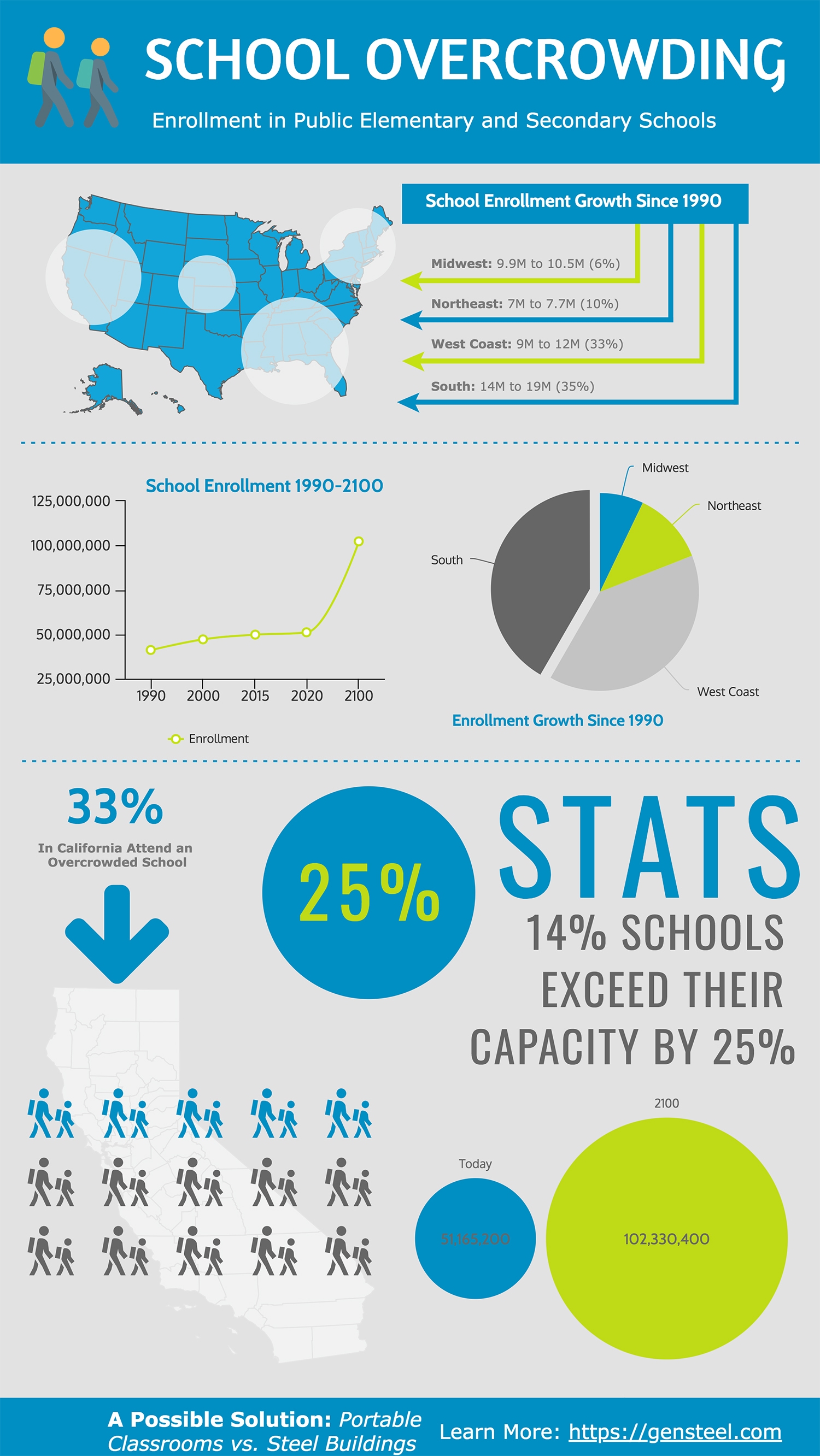
- Enrollment in public elementary and secondary schools rose 22 percent between 1985 and 2005. (National Center for Education Statistics)
- Public secondary school enrollment declined 8 percent from 1985 to 1990, but then rose 31 percent from 1990 to 2005. (National Center for Education Statistics)
- 1 of 3 California students attends an overcrowded school. (UCLA Institute for Democracy, Education and Access)
- About 14 percent of schools exceed their capacity by six to 25 percent, and eight percent exceed it by more than 25 percent. (FAIR)
- More than one-third of schools use mobile classrooms, and one-fifth hold classes in temporary instructional space (FAIR)
The size of the student body will almost double by 2100. (National Center for Education Statistics)
The Effects of Overcrowding
Higher school enrollment means greater wear and tear on the school building itself. In a study by the National Center for Education Statistics, it was found that schools that were overcrowded were about twice as likely to have at least one building in “less than adequate condition”, when compared to schools that weren’t overcrowded. Issues with framing, floors and foundations, heating, ventilation, air conditioning and electric power were all more common in overcrowded schools as well.
Not only does overcrowding negatively affect the physical environment of the building, it also negatively affects the learning environment within the school’s classrooms. Higher class sizes mean teachers are unable to give the personalized education that many students need to progress. A 2009 study by the University of London concludes that overcrowding is at the very center of failed schools and teacher dissatisfaction.