The Short Version

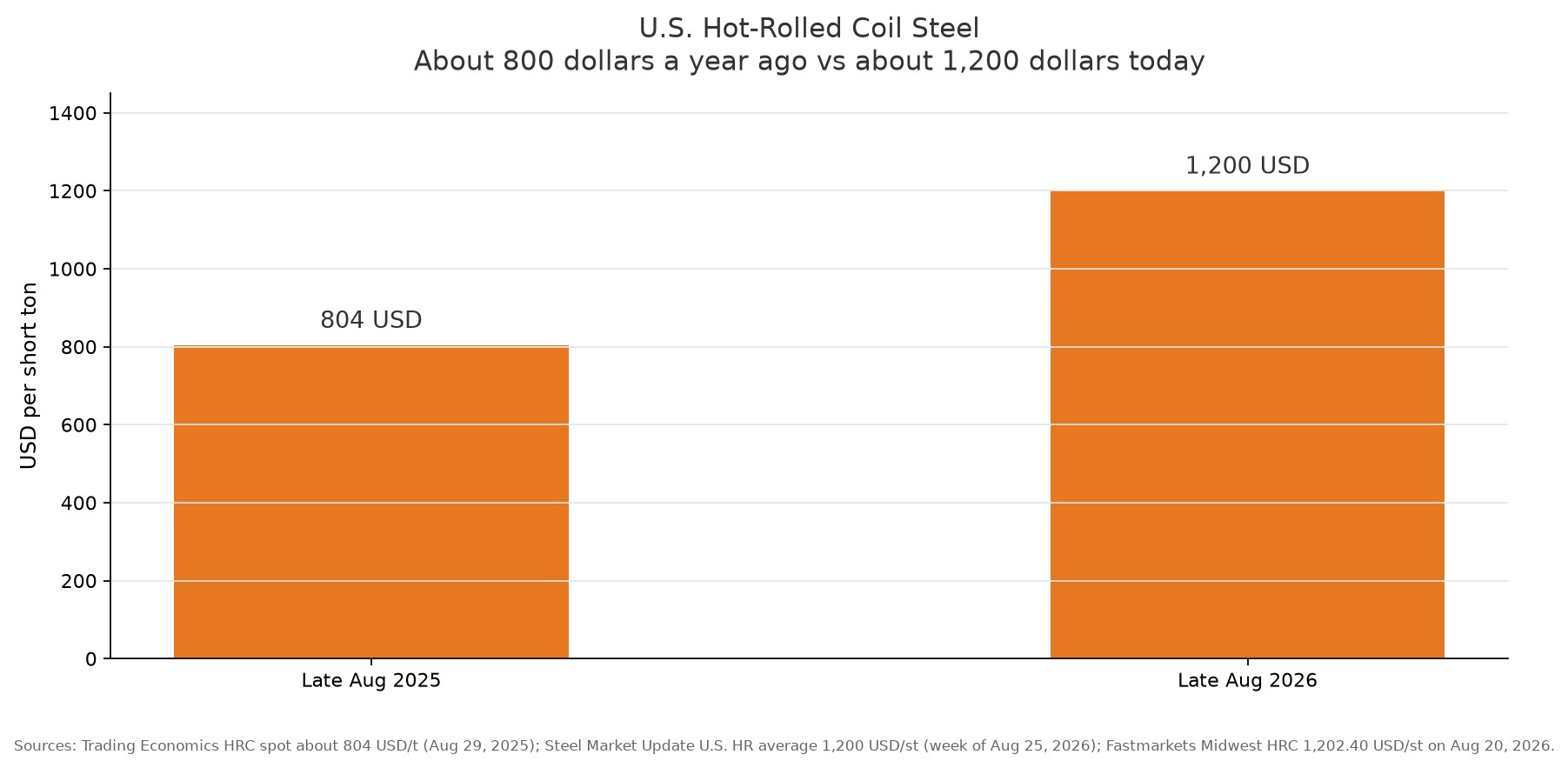
Steel is more expensive than it was a year ago, and the next year looks higher still. U.S. hot-rolled coil, the steel that goes into metal buildings, is around $1,200 a short ton in late August 2026. A year ago it was around $800.

That jump is already in the market. Quotes later may be higher because mills are taking more than a million tons of hot-rolled production offline this fall, order books for 2027 are being written at higher prices, and freight is no longer cheap. Waiting does not put you back at last year’s number.

Where Prices Are Now

As of the last week of August 2026, the U.S. hot-rolled coil average is about $1,200 a short ton (Steel Market Update, week of August 25, 2026). Fastmarkets’ Midwest HRC assessment was $1,202.40 on August 20, a four-year high.

The government’s own steel mill products index tells the same story. The BLS producer price index for steel mill products (WPU1017) was 374.2 in July 2026, preliminary. In July 2025 it was 305.5. That is the official series, not a mill price list.
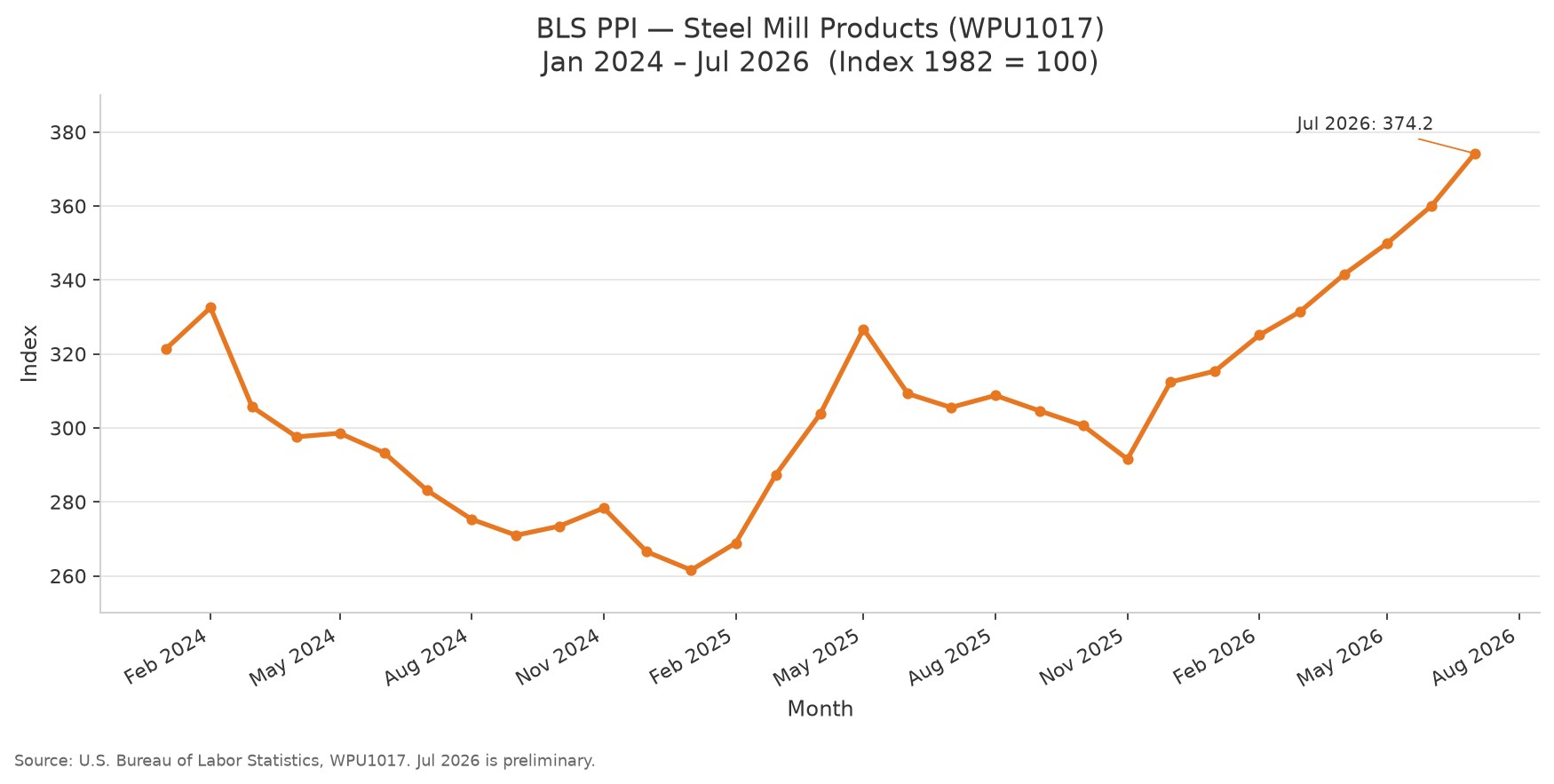
BLS PPI steel mill products WPU1017, January 2024 through July 2026
Official BLS producer price index for steel mill products. July 2026 is preliminary.

Why This Year Is Different

Three things are stacking at once.

  • Tariffs are still 50 percent. The Section 232 steel tariff went to 50 percent on June 4, 2025, and that is still the law. Talks about cutting Canada’s rate from 50 percent back to 25 percent have been in the news. Nothing is signed. Until a proclamation is signed, treat that as noise, not a price drop.
  • Mills are taking steel off the market. Fall and winter outages are set to pull more than 1 million tons of hot-rolled coil out of the U.S. market between September and December 2026 (Fastmarkets, August 21, 2026). Spot supply is already tight. Lead times are running 8 to 12 weeks.
  • 2027 contracts are resetting higher. At SMU’s Steel Summit 2026, CRU’s Josh Spoores said next year’s fixed-price contracts are lining up around $1,100 to $1,175 a ton, versus about $800 on 2026 contracts. Wells Fargo’s view is about $1,000 in 2027 if tariffs stay. Either number is well above last year.
U.S. hot-rolled coil, late August 2025 vs late August 2026
About $800 a year ago vs about $1,200 today.

About Steel Futures

Futures are a bet on tomorrow, not a quote on your building. As of August 27, 2026, the CME hot-rolled coil curve was actually lower further out, from about $1,203 for September down toward about $1,057 by late 2027. That is not a quote on your building.

Even the back of that curve is hundreds of dollars above last year’s $800s. And futures do not capture mill outages, 8- to 12-week lead times, or the 2027 contracts mills are writing now. Those are what set what you pay for a building.

What Really Drives Your Building Price

Domestic Factors

  • CheckmarkThe strength of the United States dollar
  • CheckmarkDemand for steel used in any product
  • CheckmarkTariffs & trade routing (S232 at 50%; UK at 25%; expanded derivative coverage via BIS inclusion process)
  • CheckmarkZIP‑code engineering loads (wind/snow/seismic) and code adoptions (e.g., 2024 IBC referencing ASCE 7‑22 tornado provisions for certain Risk Categories)
  • CheckmarkFreight & fuel (diesel averages $4.85 a gallon in 2026, up from $3.66 in 2025)
  • CheckmarkAccessories & schedule (doors, insulation, mezzanines, expedited lead times)

Global Factors

  • CheckmarkGeneral condition of the world economy
  • CheckmarkNatural disasters
  • CheckmarkWars and other political events

Outlook: Late 2026 into 2027

Near term, expect the tight spot market to hold through the fall outage season and the usual fourth-quarter order rush.

Into 2027, the people who sell steel for a living are booking contracts hundreds of dollars above 2026. That is the number that will show up in building quotes next year.

The honest read: steel already moved. The next move on the things that actually price a building, mill lead times and 2027 contracts, is not back to $800. If you are pricing a building, last year’s $800 steel is not coming back.

Frequently Asked Forecast Questions

Citations and Article Sources

  • Steel Market Update, U.S. offshore hot-band prices, August 27, 2026. https://www.steelmarketupdate.com/2026/08/27/us-offshore-hot-band-prices-on-the-rise/
  • Fastmarkets, fall/winter outages to take out 1 million tons of HRC, August 21, 2026. https://www.fastmarkets.com/insights/fall-winter-outages-to-take-out-1-mln-tons-of-hrc-in-us-market/
  • U.S. Bureau of Labor Statistics, PPI steel mill products WPU1017. https://data.bls.gov/timeseries/wpu1017?from_year=2024
  • White House, adjusting imports of aluminum and steel, June 3, 2025. https://www.whitehouse.gov/presidential-actions/2025/06/adjusting-imports-of-aluminum-and-steel-into-the-united-states/
  • Steel Market Update, Steel Summit analysts look ahead to 2027, August 28, 2026. https://www.steelmarketupdate.com/2026/08/28/steel-summit-analysts-look-ahead-to-2027/
  • EIA Short-Term Energy Outlook, petroleum products, August 11, 2026. https://www.eia.gov/outlooks/steo/report/petro_prod.php
  • Steel Market Update, hot-rolled futures table, August 27, 2026. https://www.steelmarketupdate.com/data-tools/hot-rolled-futures/

What this Means for Your Building

A metal building kit is mostly steel. When coil jumps a few hundred dollars a ton, the kit price follows. Freight used to offset some of that. It does not anymore. The EIA’s August 2026 Short-Term Energy Outlook puts average retail diesel at $4.85 a gallon in 2026, versus $3.66 in 2025. Hauling a building kit is more expensive this year, not less.